The latest research article, “On Contributions of Multiscale Dynamic Processes to the Steric Height in the Northeastern South China Sea as Revealed by Moored Observations”, was published online by the internationally renowned journal Geophysical Research Letters. The achievement was completed by the research team led by Professor Zhiwei Zhang (the corresponding author) of the Frontiers Science Center for Deep Ocean Multispheres and Earth System (DOMES) of Ocean University of China.Mingfang Miao is the first author of this achievement.
Based on 2-year moored measurements in the northeastern South China Sea, contributions of multiscale dynamic processes to steric height (SH) at 60 m are quantified. It shows that on average, root-mean-squared (RMS) SHs of mesoscales, submesoscales, diurnal and semidiurnal internal tides (ITs), and supertidal internal gravity waves (IGWs) are 7.56, 1.01, 1.19, 2.84, and 1.46 cm, respectively, with their respective relative contributions of 53.8%, 7.2%, 8.5%, 20.2%, and 10.4%. The SHs of ITs and supertidal IGWs are dominated by stationary and nonstationary components, respectively. Seasonally, mesoscales and submesoscales show larger RMS SHs in winter than summer but the opposite occurs for ITs and supertidal IGWs. Although the RMS SH of submesoscales exceeds nonstationary ITs in winter, it is much smaller than the sum of nonstationary ITs and supertidal IGWs. Therefore, to detect submesoscales using SWOT data, approaches to remove the SHs of nonstationary ITs and supertidal IGWs are called for.
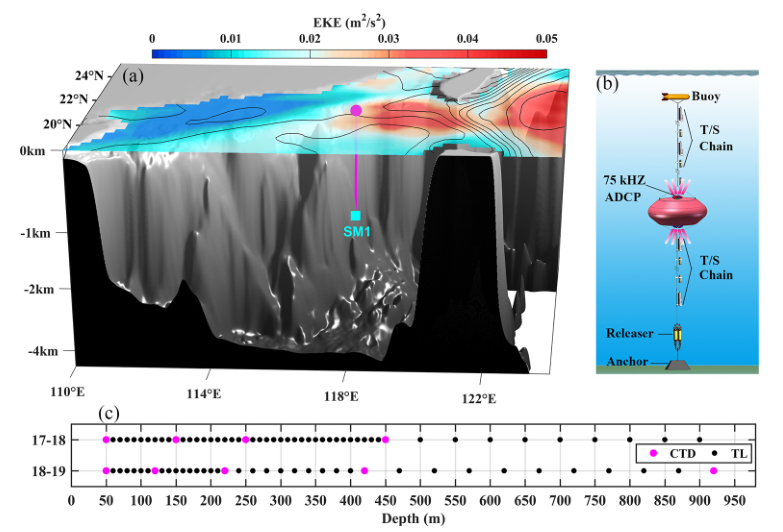
Fig.(a) Topography and the mooring location. Color shading and black contours at surface denote the altimeter-derived mean mesoscale eddy kinetic energy and sea surface height (SSH), respectively. Mooring location is indicated using purple dot and line. (b) Schematic diagram of the configuration of the mooring. Names of the instruments are marked in the diagram. (c) The designed depths of Conductivity-Temperature-Depths (CTDs; red dots) and temperature loggers (black dots) during the 2 years.

