On June 1th, the latest research article, “Interannual Variability of Tropical Atlantic-to-Pacific Moisture Transport Linked to ENSO, Atlantic Niño, and the Freshwater Budget in the Northwestern Tropical Atlantic”, was published online by the internationally renowned journal Journal of Climate. The achievement was completed by the research team led by Professor Xiaopei Lin (the corresponding author) of the Frontiers Science Center for Deep Ocean Multispheres and Earth System (DOMES) of Ocean University of China.Junchao Yang is the first author of this achievement.
Moisture transport from the Atlantic to Pacific is important for the basin-scale freshwater budget and the formation of meridional ocean circulation. Although the climatological tropical Atlantic-to-Pacific moisture transport (TAPMORT) has been well investigated, few studies have focused on its variability. Here, a detailed investigation is conducted on the interannual variability of TAPMORT based on the atmospheric reanalysis datasets. The TAPMORT interannual variability is dominated by the variations of transbasin winds across Central America, and peaks in late boreal summer and late boreal winter. 1) In late summer, a developing El Niño and a mature Atlantic Niña set up an interbasin sea surface temperature (SST) gradient that strengthens the low-level jet across Central America and therefore TAPMORT (with weakened TAPMORT for opposite signed events). This process typically occurs from July to September, with a peak in August. 2) In late winter, the strengthened southern North American center of the Pacific–North American (PNA)-like pattern intensifies the TAPMORT variations. Although atmospheric interannual variability dominates these variations, extreme El Niño events are also important for the teleconnections. This process shows a single peak in February, in contrast to the persistent peak in late summer. Further demonstration shows that the persistent TAPMORT variability in late summer dominates the moisture divergence over the north-western tropical Atlantic and modulates freshwater flux there. Thus, this study improves the understanding of how TAPMORT interannual variability and the related interbasin SST gradient regulate the northwestern tropical Atlantic freshwater budget and the related salinity variability.
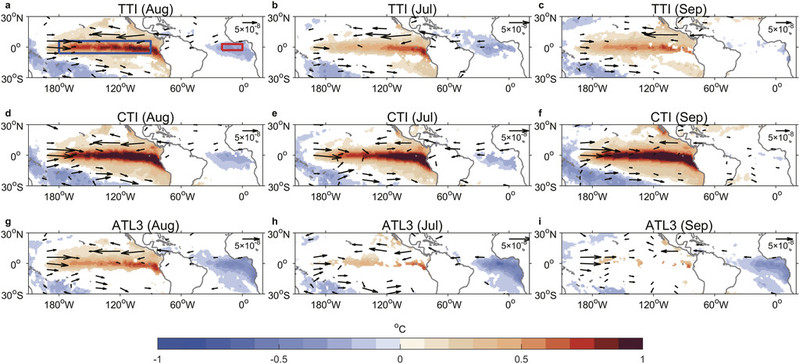
Fig. The regression pattern of SST interannual anomalies (shading; only regression coefficients exceeding 99% statistical confidence level are shown) and VIMT (Sv m−1; vectors; only regression coefficients exceeding 10−8 Sv m−1 are shown) against the normalized (a)–(c) TTI, (d)–(f) CTI, and (g)–(i) ATL3 index interannual variability in (left) August, (center) July, and (right) September. Note that the sign of values in the bottom row is reversed for convenient comparison. In (a), the blue rectangle denotes the calculation region of the CTI and the red rectangle denotes the calculation region of the ATL3 index.

