On October 25th, the latest research article, “Acrylate protects a marine bacterium from grazing by a ciliate predator”, was published online by the internationally renowned Journal Nature Microbiology .The achievement was completed by the research team led by Professor Yuzhong Zhang (the corresponding author) of the Frontiers Science Center for Deep Ocean Multispheres and Earth System (DOMES) of Ocean University of China.Zhaojie Teng (PhD candidate in the research team), Associate Professor Peng Wang from the College of Marine Life Sciences, and Professor Xiulan Chen from Shandong University are the co-first authors.
Cleavage of dimethylsulfoniopropionate (DMSP) can deter herbivores in DMSP-producing eukaryotic algae; however, it is unclear whether a parallel defence mechanism operates in marine bacteria. Here we demonstrate that the marine bacterium Puniceibacterium antarcticum SM1211, which does not use DMSP as a carbon source, has a membrane-associated DMSP lyase, DddL. At high concentrations of DMSP, DddL causes an accumulation of acrylate around cells through the degradation of DMSP, which protects against predation by the marine ciliate Uronema marinum. The presence of acrylate can alter the grazing preference of U. marinum to other bacteria in the community, thereby influencing community structure.
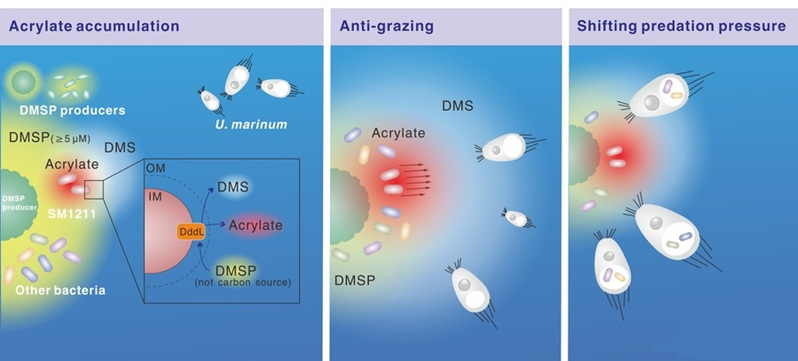
Fig. Puniceibacterium antarcticum SM1211

