On September 24th, the latest research article, “Anthropogenic impacts on nutrient variability in the lower Yellow River”, was published online by the internationally renowned Journal Science of the Total Environment. The achievement was completed by the research team led by Professor Sumei Liu (the corresponding author) of the Frontiers Science Center for Deep Ocean Multispheres and Earth System (DOMES) of Ocean University of China. Nian Wu is the first author of this achievement.
Excessive nutrient discharges and changes in nutrient ratios caused by global change and anthropogenic activities have been reported in global rivers; however, the actual alterations occurring in the Yellow River environment is too fast to catch up with. From 2001 to 2018, dissolved inorganic nitrogen (DIN), dissolved inorganic phosphorus (DIP) and dissolved silicon (DSi) concentrations showed decreasing trends in the lower Yellow River throughout the study period. Dissolved organic phosphorus (DOP) concentrations increased since 2009, reaching up to 95% of the total dissolved phosphorus. Annual minimum dissolved organic nitrogen concentrations increased with time. Extremely low nutrient concentration events have been observed since 2014 in response to the retention effect of large reservoirs; this significantly reduced the downstream water discharge and sediment load and increased phytoplankton uptake. To further analyze the variability of nutrient fluxes, the fluxes to the Yellow River have been quantified from natural (runoff, precipitation deposition, and sediment load from the Loess Plateau), anthropogenic (recharged water, fertilizer application, and vegetation coverage), social and industrial (population urbanization, GDP, and sewage effluents) sources. The highest contributions of total nutrient fluxes emptied into the Yellow River was fertilizer losing (44–48%) for DIN, sewage effluents (85–88%) for DIP, and runoff (35–65%) for DSi, respectively. Strictly controlling the amount of fertilizer and improving the application methods, improving sewage treatment technology, and vigorously promoting “green travel” might reduce nutrients emptied into the Yellow River based on the main sources of nutrients. This study may help policy makers formulate strategies and it is possible to own a better water quality in the Yellow River.
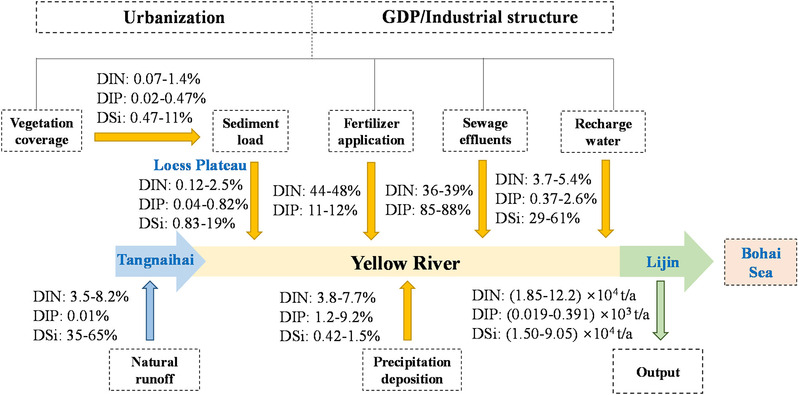
Fig. Relative contributions of various factors toward the total DIN, DIP, and DSi fluxes to the Yellow River.

