On June 11th, the latest research article, “Seasonality of dimethylated sulfur compounds cycling in north China marginal seas”, was published online by the internationally renowned Journal Marine Pollution Bulletin. The achievement was completed by the research team led by Professor Guangchao Zhuang (the corresponding author) of the Frontiers Science Center for Deep Ocean Multispheres and Earth System (DOMES) of Ocean University of China.Shihai Mao is the first author of this achievement.
Dimethylated sulfur compounds play an important role in global sulfur cycle. The study investigated the seasonality of dimethylsulfoniopropionate (DMSP), dimethylsulfoxide (DMSO), dimethylsulfide (DMS) and associated processes in two north China marginal seas during 2014 and 2016. High concentrations of DMS, DMSP and DMSO occurred in summer/spring, while the lowest were observed in winter. This clear seasonality was primarily driven by biomass abundance and phytoplankton communities, reflected in chlorophyll a concentrations and the composition/ratios of diatoms and dinoflagellates. The spring maximum was attributed to the annual occurrence of algal bloom. The sea-to-air fluxes of DMS also varied largely between seasons, with an average of 8.84, 11.87, 10.50 and 2.14 μmolm-2 day-1 in spring, summer, autumn and winter, respectively. Given the seasonal uncertainty of sea-to-air flux, the seasonality or situations where specific blooms occur regularly should be considered for accurate estimation of annual global DMS emission.
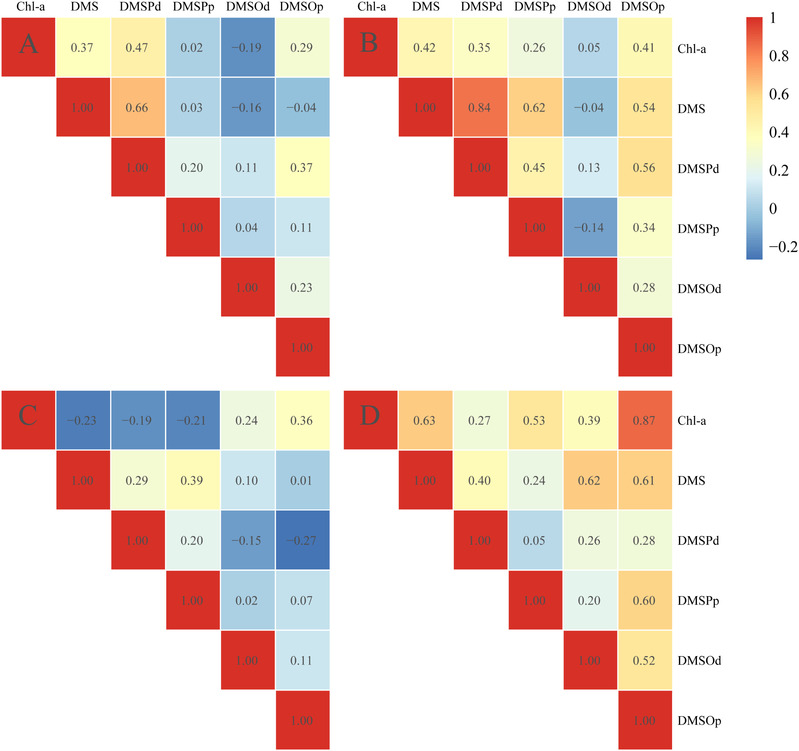
Fig. Correlation of DMS, DMSP, DMSO and Chl-a in spring (A), summer (B), autumn (C) and winter (D)
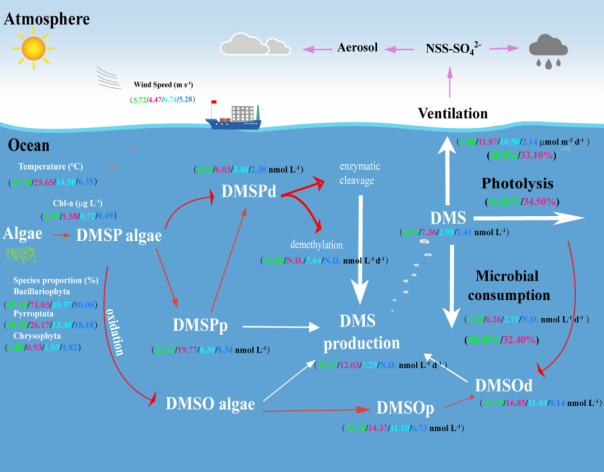
Fig. DMS, DMSP and DMSO cycling in the North China marginal seas

