The latest research article, “The trials and tribulations of the Hawaii hot spot model”, was published online by the internationally renowned Journal Earth-Science Reviews. This achievement was jointly completed by Professor Zhaoxia Jiang, Professor Sanzhong Li and other collaborators from the Frontiers Science Center for Deep Ocean Multispheres and Earth System (DOMES) of Ocean University of China.
The Hawaiian-Emperor volcanic chain (H-E chain) is located in the middle of the North Pacific Ocean. It extends from northwest to southeast, including two segments, the older Emperor chain and the younger Hawaiian chain between which is a 60o change in strike, here termed the H-E bend. The H-E chain is the clearest and most intensively researched hot spot track in terms of plate motion, mantle plumes, tectonics, geochemical evolution, and lithospheric studies. However, debates on the formation of the H-E chain, in particular the H-E bend, concerning its origin in hot spot drift and/or Pacific plate motion change, have been ongoing for several decades. In this paper, current understanding and ideas concerning this debate are reviewed, and ways forward are suggested. So far, neither hot spot southerly drift nor Pacific plate motion change can perfectly account for the geometry and progression of the H-E chain. In this review, a joint model is put forward where these two competing processes together can reasonably explain the evolution of the H-E chain and the H-E bend. In addition, three stages for formation of the H-E chain are proposed, including: 1) A ridge-plume interaction stage: Meiji~Detroit seamounts and a possible subducted section; 2) A combination of hot spot-Pacific plate motion: South of Detroit seamount ~ H-E bend; and 3) Pacific plate motion with a fixed hot spot: Hawaiian volcanic chain. In addition, any plate movement at the surface must be balanced by motion deeper in the mantle. Therefore, it is considered that the surface Pacific plate motion and the state of deep mantle plume at 47–55 Ma are not totally separated but co-evolved. Furthermore, reconstructions of the Pacific plate and its boundaries should be considered if Hawaiian hot spot motion makes great contributions to the formation of the H-E chain. Nevertheless, establishing the causal links between these events and their underlying dynamic triggers requires further, more comprehensive work.
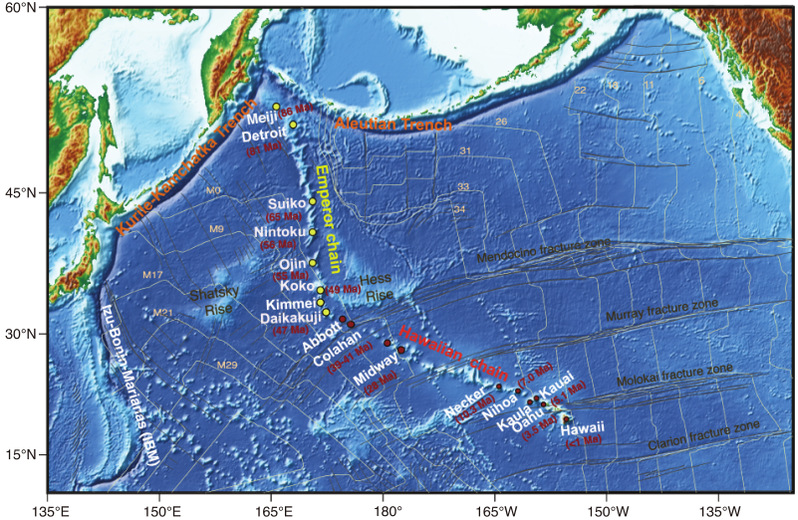
Fig. Geological setting of the Hawaiian-Emperor seamount chain plotted by the Generic Mapping Tools (GMT).

