On March 17th, the latest research article, “Spatio-temporal evolution and dynamic origin of Jurassic-Cretaceous magmatism in the South China Block”, was published online by the internationally renowned Journal Earth-Science Reviews. This work was completed jointly by Postdoctoral Fellow Xianzhi Cao and Professor Sanzhong Li from the Frontiers Science Center for Deep Ocean Multispheres and Earth System (DOMES), Ocean University of China, in collaboration with Lecturer Nicolas Flament from the University of Wollongong and Professor Dietmar Müller from The University of Sydney, Australia.
Widespread igneous rocks were emplaced in the eastern South China Block (SCB) from the Jurassic to the Cretaceous period. These rocks include granitoids and rhyolites, and minor mafic and rare intermediate igneous rocks, of unclear geodynamic origins. A total of 780 published igneous rock ages were compiled to age-code a 1:500,000 digital geological map, which was then used to analyze the spatio-temporal evolution of the associated magmatism. Regional igneous rocks can be divided into four major emplacement episodes: 190–175 Ma, 165–155 Ma, 145–125 Ma, and 105–95 Ma, with the first two episodes dominated by intrusive rocks emplaced in the Jurassic in inland South China (~550–1200 km away from the trench), and the latter two episodes mostly eruptive rocks emplaced in the Cretaceous along coastal areas (~400–800 km away from the trench). To investigate the association of these events with the history of subduction, the slab flux along eastern China was calculated using two published global plate tectonic reconstructions. Results show that the slab flux (per kilometer) between ~145 Ma and 120 Ma along eastern China was up to 0.018 km²/yr, which is much larger than the global average for the last 200 Myr (0.005 km²/yr); this period of large slab flux largely coincides with Early Cretaceous magmatism in the region. Combined with the geochemical characteristics of these rocks, the results indicate that Cretaceous magmatism in South China was related to underplating caused by dehydration of the subducting Izanagi slab. In contrast, the slab flux was much lower (0.003–0.007 km²/yr) during the period of Jurassic magmatism. The two considered plate reconstructions were adopted to drive three mantle flow models, which predict that upper mantle upwellings occurred beneath the SCB in the Jurassic, triggered by subducting slabs. A hydrous mantle transition zone, which could have developed due to long-term subduction around the SCB, is likely to have facilitated these mantle upwellings and caused partial mantle melting. The findings further reveal that these mantle upwellings and associated hydrous melting, could have caused the melting of continental crust and induced Jurassic intraplate magmatism in the SCB.
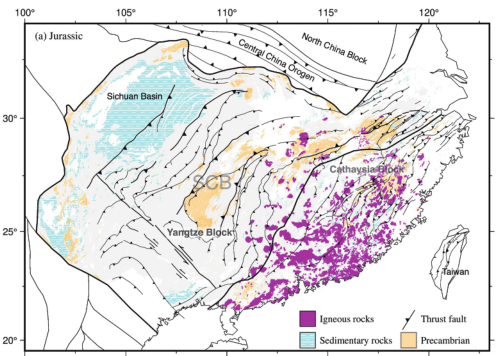
Fig. Deformation and magmatism in the SCB during the (a) Jurassic

