On September 2th, the latest research article, “Fabrication of MIL-Fe (53)/modified g-C3N4 photocatalyst synergy H2O2 for degradation of tetracycline”, was published online by the internationally renowned Journal Separation and Purification Technology. The achievement was completed by the research team led by Professor Mutai Bao(the corresponding author) of the Frontiers Science Center for Deep Ocean Multispheres and Earth System (DOMES) of Ocean University of China.Yaping Pan is the first author of this achievement.
An improved porous g-C3N4 material was prepared by calcination with equal quality of melamine and cyanuric acid. The improved g-C3N4 was recorded as CM and an appropriate amount of MIL-Fe (53) was loaded on the CM to synthesize Fe-MOF/CM (denoted as x% Fe-MOF/CM, which x was the mass of MIL-Fe (53) for a given amount of CM) by self-assembly synthesis method. Photocatalytic degradation experiments showed that the 3 % Fe-MOF/ CM-H2O2 system can degrade 100 % tetracycline (10 ppm) within 60 min. The efficiency of this system to degrade tetracycline was about 3.6 times than that of pure g-C3N4 . More importantly, the 3% Fe-MOF/CM-H2O2 photocatalyst system still has excellent degradation effect on high concentration of TC (30 ppm), which can reach about 100 % within 60 min. This system exhibited high degradation efficiency of TC than g-C3N4 and CM, especially under the high concentration of TC condition. The reason could ascribe the addition of Fe-MOF enhanced the adsorption performance of the material. Moreover, Fe3+ and H2O2 formed a Fenton-like system, which enabled the rapid separation of e - and h + . Finally, the possible degradation pathway was suggested through the intermediates identified by GC–MS. The photocatalytic mechanism would provide some suggestions for degradation of TC in waste water.
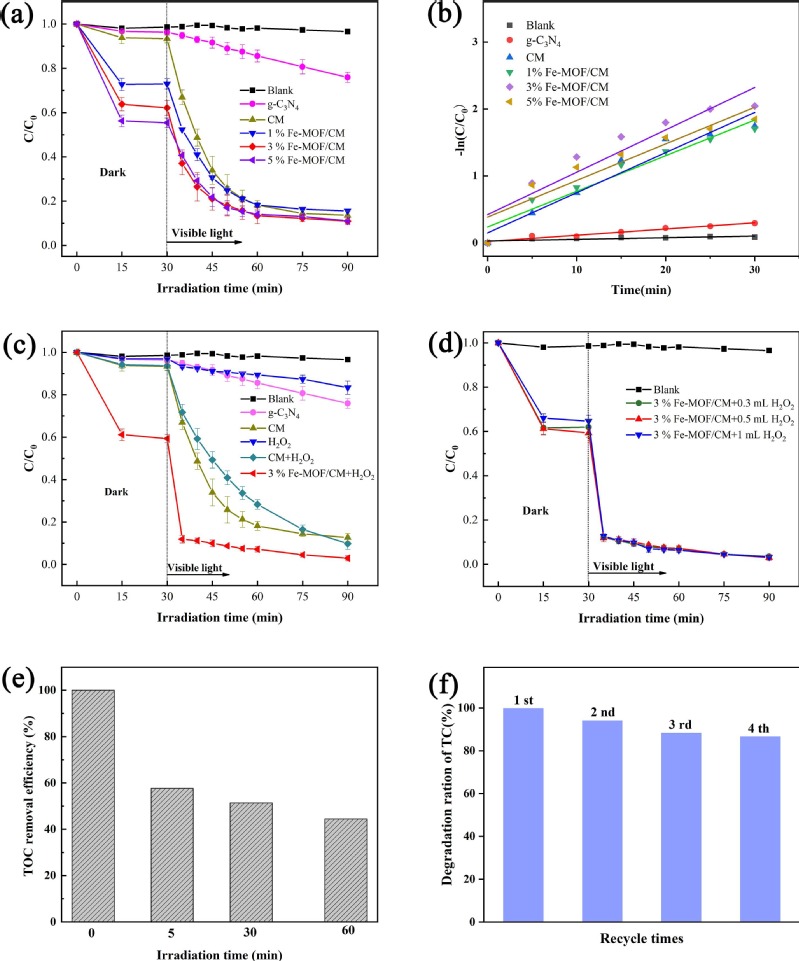
Fig.(a) Photocatalytic degradation of TC by different photocatalytic materials; Experimental conditions: [TC] = 10 ppm, [Catalyst] = 0.375 g/L. (b) The pseudo-first-order kinetics diagram of photocatalytic materials; Experimental conditions: [TC] = 10 ppm, [Catalyst] = 0.375 g/L. (c) Photocatalytic degradation of TC by different photocatalytic materials under the condition of adding appropriate amount of H2O2. (d) Photocatalytic degradation of 3 % Fe-MOF/CM system by adding different volume of H2O2. (e) TOC removal efficiency of 3 % Fe-MOF/CM + H2O2 system in the process of photodegradation; (f) Cyclic use of 3 % Fe-MOF/CM photocatalyst.
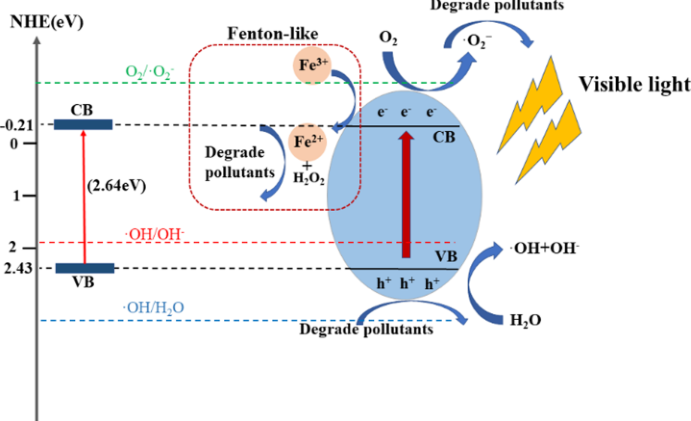
Fig.Schematic diagram of possible photocatalytic degradation mechanism of 3 % Fe-MOF/CM photocatalytic materials under visible light conditions

