The latest research article, “Hydrolyzed polyacrylamide-containing wastewater treatment using ozone reactor-upflow anaerobic sludge blanket reactor-aerobic biofilm reactor multistage treatment system”, was published online by the internationally renowned Journal Environmental Pollution. The achievement was completed by the research team led by Professor Mutai Bao (the corresponding author) of the Frontiers Science Center for Deep Ocean Multispheres and Earth System (DOMES) of Ocean University of China. Tianwen Song and Shanshan Li are the co-first authors of this study.
Polymer flooding is one of the most important enhanced oil recovery techniques. However, a large amount of hydrolyzed polyacrylamide (HPAM)-containing wastewater is produced in the process of polymer flooding, and this poses a potential threat to the environment. In this study, the treatment of HPAM-containing wastewater was analyzed in an ozonic-anaerobic-aerobic multistage treatment process involving an ozone reactor (OR), an upflow anaerobic sludge blanket reactor (UASBR), and an aerobic biofilm reactor (ABR). At an HPAM concentration of 500 mg/L and an ozone dose of 25 gO3 /g TOC, the HPAM removal rate reached 85.06%. With fracturing of the carbon chain, high-molecular-weight HPAM was degraded into low-molecular-weight compounds. Microbial communities in bioreactors were investigated via high-throughput sequencing, which revealed that norank_c_Bacteroidetes_vadinHA17, norank_f_Cytophagaceae, and Meiothermus were the dominant bacterial groups, and that Meth-anobacterium, norank_c_WCHA1-57, and Methanosaeta were the key archaeal genera.To date, this represents the first investigation in which HPAM-containing wastewater is treated using an ozonic-anaerobic-aerobic multistage treatment system. The ideal degradation performance and the presence of keystone microorganisms confirmed that the multistage treatment process is feasible for treatment of HPAM-containing wastewater.
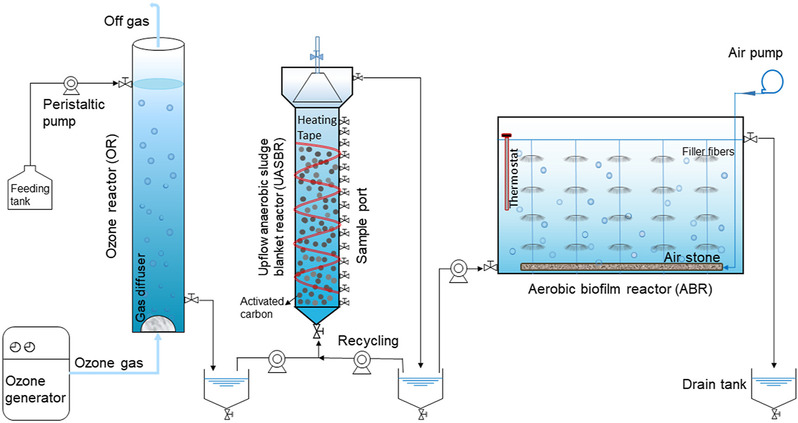
Fig. Schematic flow diagram of the OUA multistage treatment system.
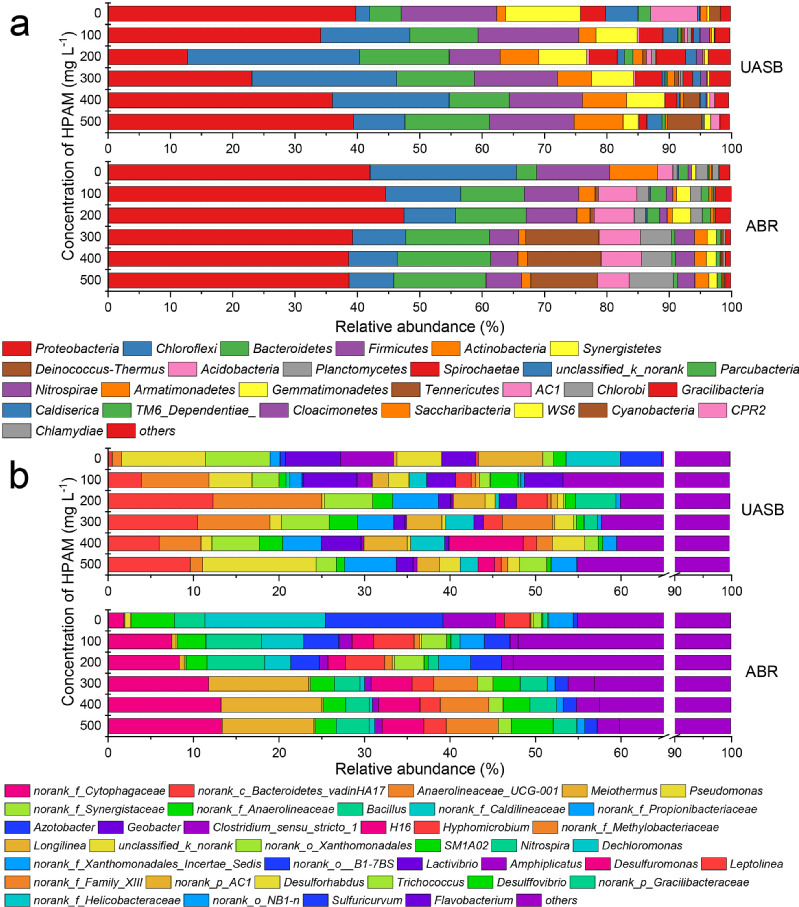
Fig. Phylum-level (a) and genus-level (b) distributions of bacterial populations in the bioreactors involved in the biodegradation of HPAM and its ozonation intermediates.

