On November 21th, the latest research article, “Emissions and potential controls of light alkenes from the marginal seas of China”, was published online by the internationally renowned Journal Science of the Total Environment. This achievement was completed by the research team led by Professors Guipeng Yang and Honghai Zhang (Corresponding Author) from the Frontiers Science Center for Deep Ocean Multispheres and Earth System (DOMES), Ocean University of China. Jianlong Li is the first author of this work.
Marine-derivedreactivegasesconstituteasubstantialfractionofvolatileorganiccompoundsanddirectlyimpact atmospheric chemistry and the global climate. Light alkene emissions from marginal seas are limited, and their contribution to atmospheric concentrations is likely under estimated. Oceanic emissions of ethylene, propylene, and isoprene, as well as their potential controlling factors in the marginal seas of China, were surveyed during the cruises in 2014–2015. Significant temporal-spatial variations in ethylene, propylene, and isoprene concentrations were observed, with the highest occurring in summer near the coastal regions. Isoprene concentrations were primarily controlled by phytoplankton biomass (i.e., Chl-a) in coastal regions, while the elevated concentrations of ethylene and propylene were attributed to photochemical reactions with the high levels of dissolved organic matter (DOM). Additionally, the vertical distributions of ethylene and propylene mirrored light penetration, with exponential decrease in concentrations with depth. However, there were high values of ethylene and propylene observed at deep chlorophyll maximum, suggesting the existence of non-photochemical production path-ways, most likely biological origin. Emissions of ethylene, propylene, and isoprene from the marginal seas of China were estimated to be 0.022, 0.024, and 0.011TgCyr−1 , respectively, indicating they are important contributors to globalnon-methanehydrocarbons.
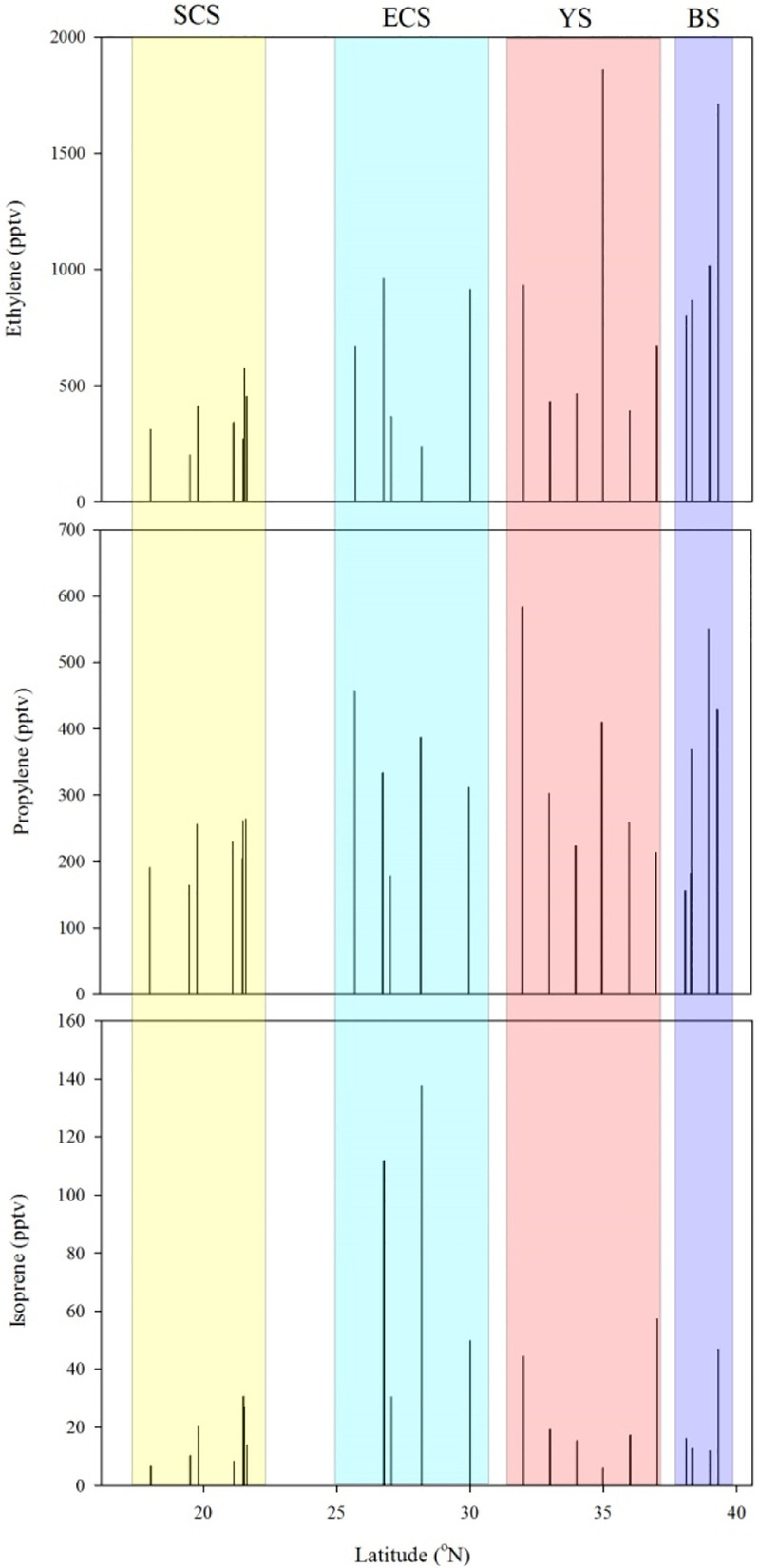
Fig. Latitudinal distributions of ethylene, propylene, and isoprene (pptv) over the South China Sea (SCS), East China Sea (ECS), Yellow Sea (YS), and Bohai Sea (BS) during summer.

