Recently, the latest research article, “A study of predictability of coupled ocean–atmosphere system using attractor radius and global attractor radius”, was published by the internationally renowned journal Climate Dynamics. The achievement was completed by the research team led by Professor Shaoqing Zhang and Professor Jianping Li (the corresponding author) of the Frontiers Science Center for Deep Ocean Multispheres and Earth System (DOMES) of Ocean University of China. Haoran Zhao is the first author of this achievement.
The research reveals while ocean–atmosphere coupled models play an increasingly important role in weather-climate simulation and prediction, the predictability theory based on an atmosphere-only model has significant limitations in interpreting prediction results and guiding predictability studies. Here a conceptual ocean–atmosphere coupled model is used that describes the typical interactions of a synoptic-scale atmosphere with a seasonally-interannually varying upper ocean as well as a deep ocean that varies on decadal timescales to systematically study the predictability of a coupled system. Moving from an atmosphere- only system to an ocean–atmosphere coupled system, the initial-value predictability problem becomes a joint initial-value and boundary-value problem. Although the coupling process increases the uncertainties of the boundary, ocean signals with longer timescales are added to the atmosphere system, thus increasing its predictability. An investigation is then conducted on the predict-ability characteristics of the National Centers for Environmental Prediction coupled Climate Forecast System (CFS) and the uncoupled Global Ensemble Forecast System (GEFS). In the coupled CFS system, the practical predictability limit of the lower troposphere is significantly longer than in the uncoupled GEFS due to the contribution of low-frequency boundary signals from air-sea interactions. While further deep and thorough examination is necessary for understanding ocean predictability in the climate system, a preliminary discussion for the predictability of the upper and deep oceans within a coupled ocean–atmosphere framework is also presented in this study.
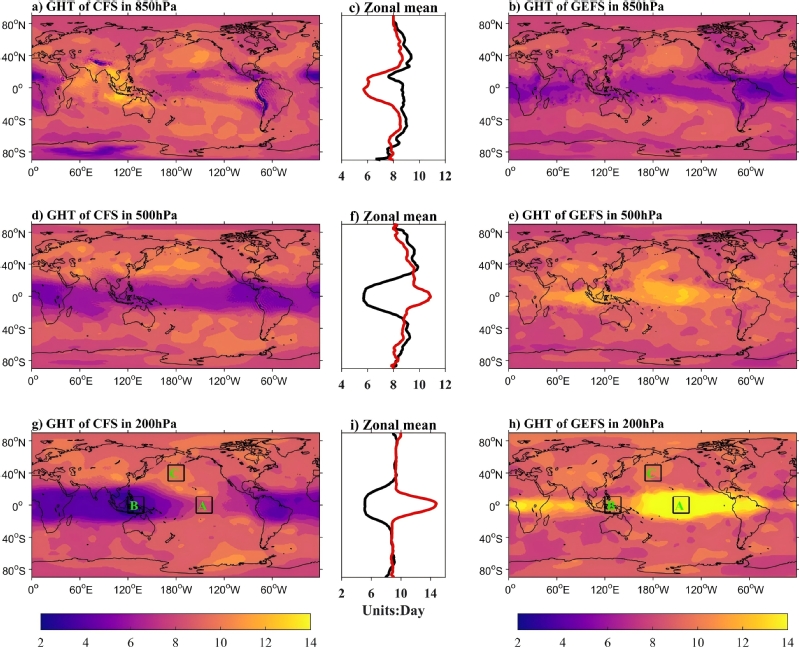
Fig. Spatial distribution of the practical predictability limit of GHT for CFS (left panel) and GEFS (right panel). The black and red lines in the middle panels of zonal mean profile are practical predictability limit of CFS and GEFS, respectively. Upper, middle, and lower panels are for 850-hPa, 500-hPa, and 200-hPa, respectively

