Recently, the research article "Atmospheric Forcing of the Pacific Meridional Mode: Tropical Pacific-Driven Versus Internal Variability" has been published online in Geophysical Research Letters. This achievement was jointly completed by the research team led by Yu Zhang, Junchao Yang and Professor Xiaopei Lin from the Frontiers Science Center for Deep Ocean Multispheres and Earth System (DOMES) of Ocean University of China.
The Pacific Meridional Mode (PMM) impacts tropical Pacific sea surface temperature variations, which in turn affect the PMM through the excited atmospheric teleconnections. Previous studies linked this loop to the tropical Pacific-excited North Pacific Oscillation (NPO; the second empirical mode of North Pacific sea level pressure variability), while a recent study proposed the linkage to the excited Aleutian low (AL) variability (the first empirical mode). Unraveling their relative importance for the loop is thus crucial for better understanding subtropical-tropical interactions. Here, using tropical Pacific pacemaker experiments, it is shown that tropical Pacific-forced AL variability is tied to the loop, while the tropical Pacific-forced NPO does not effectively induce PMM variability, hence not being in the loop. This study emphasizes the role of tropical Pacific-forced AL variability in the PMM-tropical Pacific interaction, which should be paid more attention in future studies.
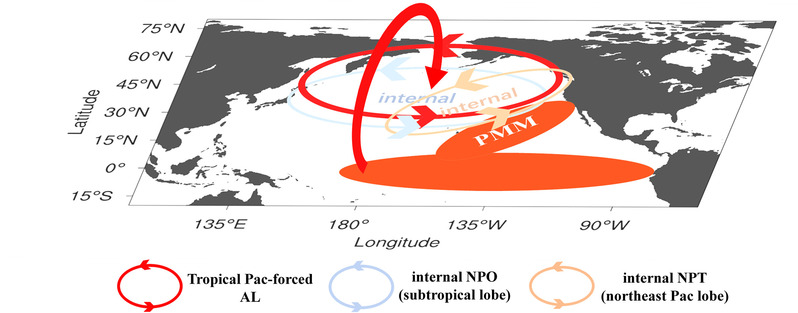
Fig. Schematic of the North Pacific atmospheric forcing of the Pacific Meridional Mode (PMM).

